It sees what you see
Before it answers “what am I looking at?”, it checks which named parts of the place are on screen and how much of the view each one fills. Tap anything with a name and the question writes itself.
The field.tours engine
The field.tours engine runs an AI agent inside a streamed 3D scan of a real place. It sees what the visitor sees, moves the camera, points at and lights up what it talks about, and answers only from the place's own cited sources. Every field.tours tour runs on it.
What it does
Six things, all working in the tours today.
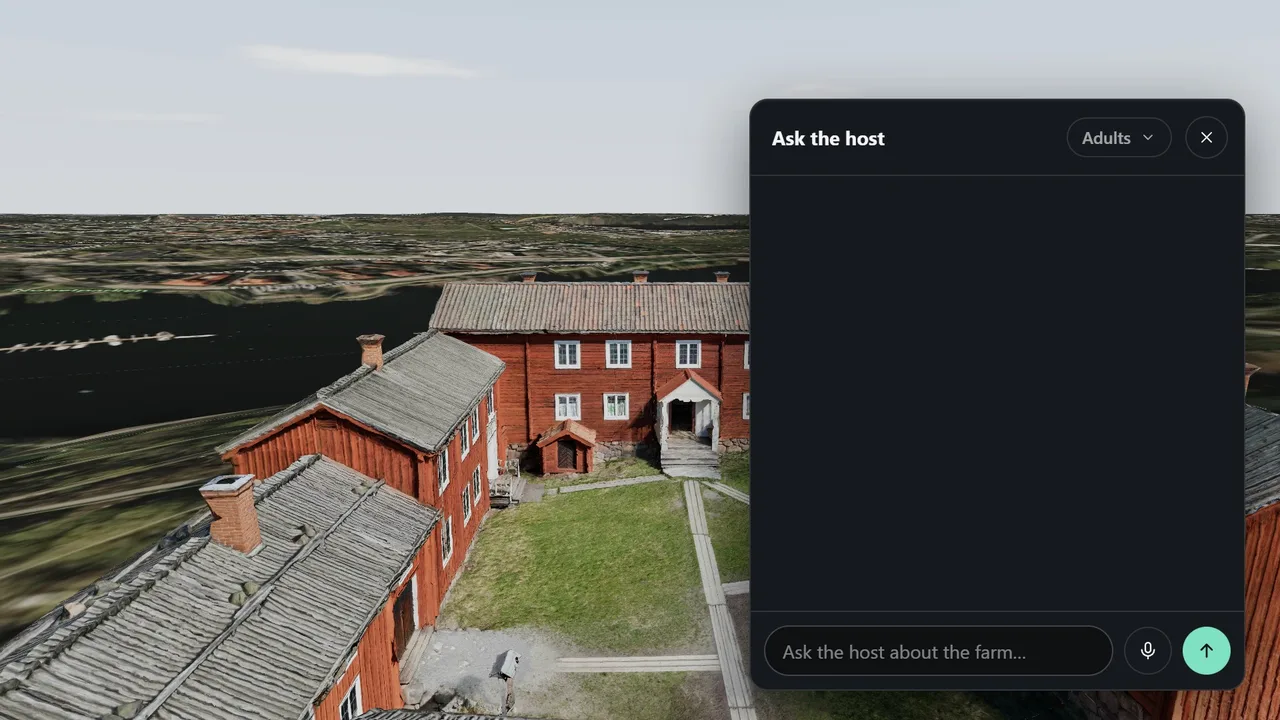 “What am I looking at?”
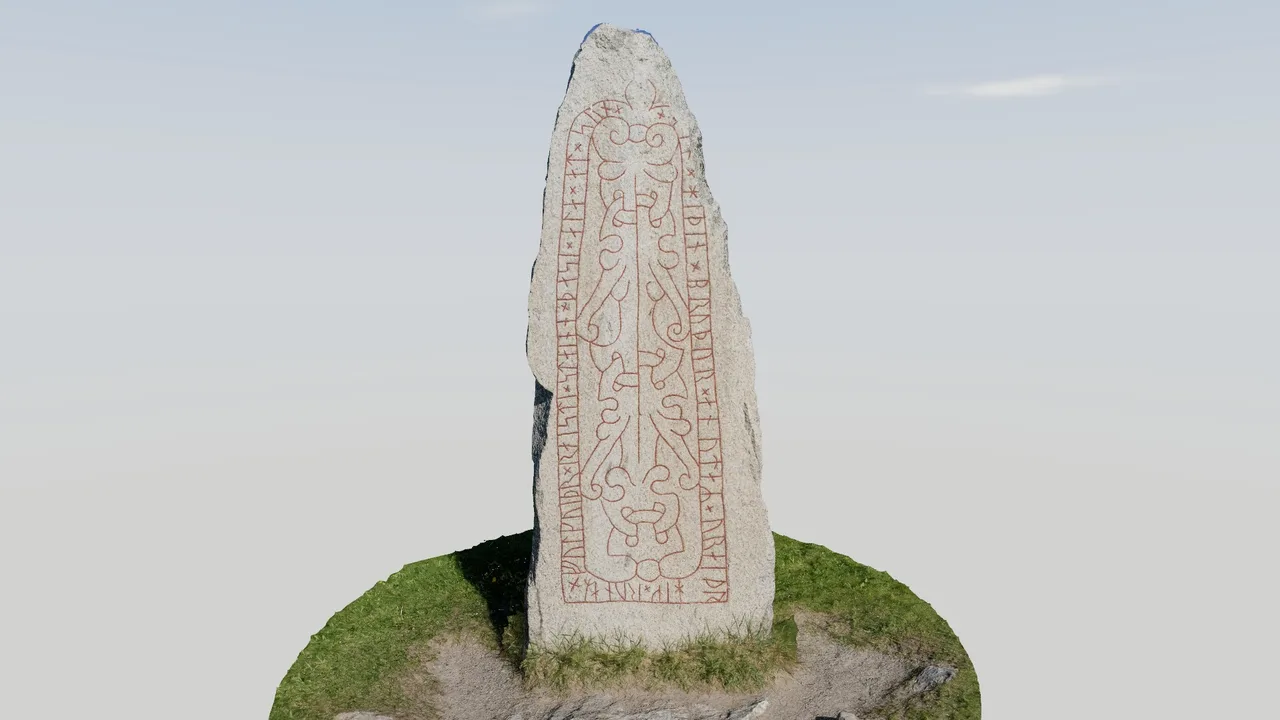 “Show me where the reading begins”
Before it answers “what am I looking at?”, it checks which named parts of the place are on screen and how much of the view each one fills. Tap anything with a name and the question writes itself.
Ask to see something and the camera flies there: to a stop on the route, or to any named part of the place, even where no stop goes. The visitor leads; the route is a suggestion.
It lights up the building, the rune or the crevasse field it is talking about, on the 3D model itself. Not a pin, not a pop-up box.
Every answer comes from texts and sources written by the people who know the place. The source is one tap away, and when something is not in them, the agent says so.
In a Custom story the agent is a character in the scene, such as a survey drone over a glacier, with actions of its own that the visitor sees it perform.
A tour can be connected to a museum's own catalogue. The agent reads the live record, so a correction made at the museum reaches the tour on the next visit.
Sources
Every part of the place that matters gets a name, a sentence about it and its sources, written by a curator, a researcher or an engineer. The agent works from those names and texts, and from nothing else.
We do not let the agent guess what something is from the pixels. A guess cannot say where it came from, and for a museum, a school or a power company an answer without a source is not an answer.
When sources disagree, the tour shows both instead of quietly picking one. Asked about something outside its material, the agent says that it is not in its sources.
That is also what separates a field.tours place from a generated 3D world: the place is measured, scanned from the real thing, and every named part of it is backed by someone who knows it.
Where it runs
The places are real scans, and the same tour runs on every screen a visitor meets.
3D Tiles, point clouds, photogrammetry, BIM/IFC and CAD models, in the billion-point class. The scan streams in tiles as the visitor moves, so a model far too big to download opens in seconds, with nothing to install.
A browser tab on a phone or a computer, full screen on a touch display in kiosk mode, and a VR headset. Standard tours draw with WebGPU where the browser has it and WebGL everywhere else.
Swedish and English from the start, more on request. Visitors type or speak, and the answers suit the audience you choose: school classes, the public or specialists.
Keyboard, screen readers and reduced motion work in every tour, because they are built into the engine rather than added per tour.
Two ways to use it
A streamed 3D model, numbered stops and your texts, with the agent answering from your sources. Stops, texts, name tags, sources and the agent's persona are content, not code, changed without a developer.
Everything a Standard tour has, plus characters with a body and a voice, animation, simulation and bespoke interaction. We write, build and deploy it; the texts stay yours to change afterwards.
Studios, integrators and developers who want to build on the engine: tell us what you have in mind
Compared
Who makes it
field.tours is made by IVAR Studios, the Stockholm studio of Martin Edström, director, and Fredrik Edström, producer, founded in 2016. More about the people behind it is on IVAR's site.
Questions
Yes. It is a language model that acts in the 3D scene as well as talking: it moves the camera, points at and lights up parts of the model, checks what is on screen and looks up the place's own material before it answers. It acts only on the place it is in, and only on what the visitor asks.
No, on purpose. People who know the place name its parts and write down what they are, with sources. The agent works with those names, so it can always say where an answer comes from. It never guesses what something is from the pixels.
Today Mistral Small through OpenRouter, with OpenAI's gpt-4o-mini as a fallback, as our privacy notice says. The engine is not tied to one model and has changed models without changes to the tours. Ask us about yours.
Yes. It works on scans, point clouds, photogrammetry, BIM/IFC and CAD models, which we convert and stream. An industrial site can be shown on your own material, with your technical documentation as the sources.
Yes. The same tour runs in a browser, full screen on a touch display in kiosk mode, and in a VR headset, with nothing to install.
It answers only from the texts and sources written for the place, cites them, and says that something is not in its sources rather than guess. Conflicting sources are shown, not quietly resolved.
Talk to us. We are looking for pilot partners and scope each first project together, and we want to hear from studios and developers who have a place, a story or a product in mind.
There is no price list. We plan a first project together with each organisation and shape the offer with our pilot partners.
See it live
The demos show everything on this page: a runestone, a farm at Skansen, a ship from 1759 and a glacier front.